Issue 12
Why Data Flow Mapping Is the Foundation of AI Governance
AI governance begins long before policies and compliance. It begins with understanding how information, decisions, and authority move through an organization. This article introduces data flow mapping as the operational foundation of effective AI governance.
By Wayne Couch ·
Introduction
When organizations begin discussing AI governance, the conversation usually starts with policies, committees, risk registers, or regulatory compliance.
Those are all important.
But they all assume something that many organizations have never fully documented:
How does information actually move through the organization?
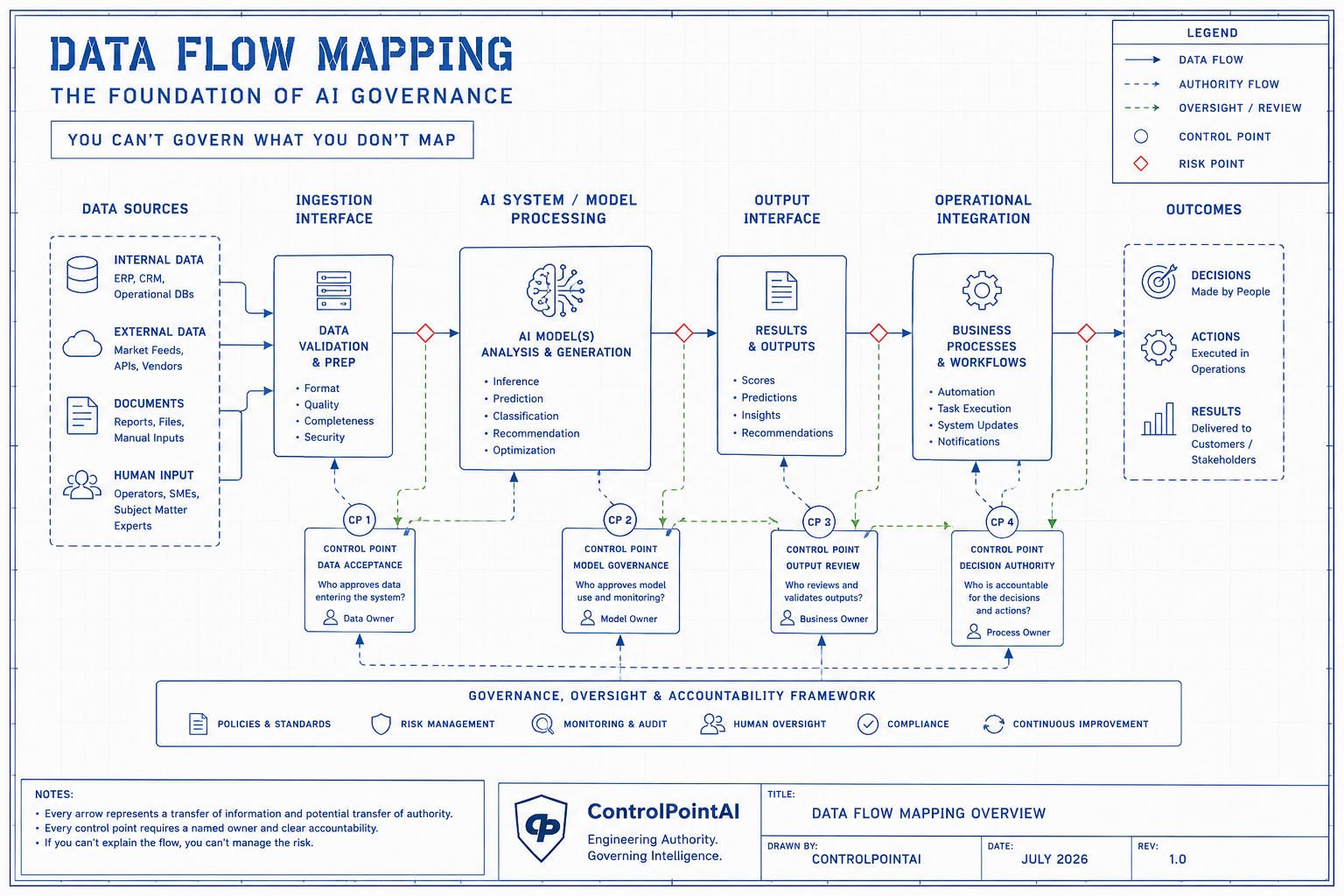
Artificial intelligence does not operate in isolation. Every AI system receives information from somewhere, transforms that information, and passes it to another person or another system. Every one of those transfers creates an operational control point where authority, accountability, and human judgment must be clearly understood.
Before an organization can govern AI, it must first understand its own operational data flows.
That is why data flow mapping is not simply another compliance exercise.
It is the operational foundation of AI governance.
An Engineer's Perspective
During my career in nuclear engineering, submarine maintenance, and systems integration, no one would attempt to modify a critical system without first understanding how every component interacted with every other component.
We relied on interface drawings, system diagrams, process maps, and engineering documentation because decisions in one part of the system could produce unintended consequences somewhere else.
Artificial intelligence introduces the same challenge.
The difference is that the interfaces are increasingly informational rather than mechanical.
Why This Matters Now
Recent developments such as the EU AI Act reinforce an important reality.
Organizations are increasingly being asked to demonstrate where AI is being used, what information it processes, who is responsible, how risk is managed, and how meaningful human oversight is maintained.
Those are governance questions.
But before they become governance questions, they are mapping questions.
If an organization cannot describe how information moves through its AI-enabled processes, it becomes much more difficult to demonstrate transparency, accountability, oversight, or regulatory compliance.
Beyond Compliance
Many governance programs begin with regulations.
ControlPointAI begins with operations.
Instead of asking, "Which regulation applies?" we begin by asking, "How does this system actually work?"
Once the operational picture is understood, regulatory requirements can be mapped onto a known system rather than guessed from policy documents alone.
Compliance becomes an outcome of understanding—not a substitute for it.
Looking Ahead
In our first article, I introduced a simple observation:
Technology is moving faster than authority.
Data flow mapping is one practical way to reverse that trend.
When organizations understand how information, decisions, and authority move through their operations, governance becomes more than a policy manual.
It becomes something that can be engineered.
That is the foundation ControlPointAI hopes to help organizations build.