Issue 4
From Algorithms to Authority
Positions Authority Engineering as the bridge between AI capability, governance intent, and operational execution.
By Wayne Couch ·
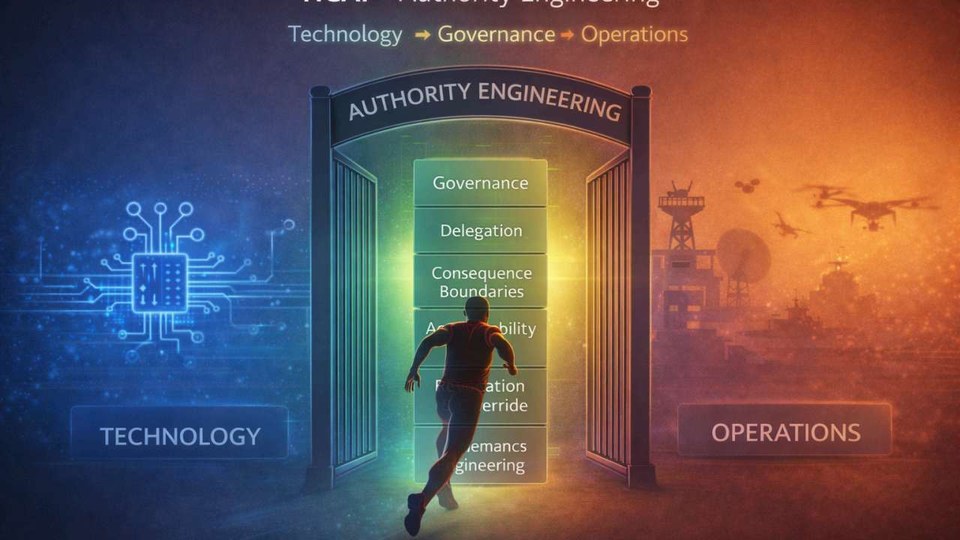
Artificial intelligence is rapidly moving from laboratory experimentation into real-world operational systems. Governments are beginning to build regulatory frameworks such as the European Union Artificial Intelligence Act, while defense organizations are integrating AI into systems designed to respond to emerging threats like drone swarms.
As AI systems move closer to operational decision-making in infrastructure, defense, and financial systems, the central challenge is no longer simply building capable algorithms. The real challenge is designing governance and authority structures that allow humans and AI systems to operate together safely inside complex institutions.
Signal 1
The EU AI Act and the Emergence of Global AI Governance
The European Union Artificial Intelligence Act represents the first comprehensive attempt by a major economic bloc to establish a regulatory framework for artificial intelligence.
Rather than regulating AI as a single technology, the EU framework classifies systems according to risk categories, with the most stringent requirements applied to "high-risk" systems.
These include AI used in:
- critical infrastructure
- transportation systems
- medical devices
- law enforcement and border control
- employment and financial decision systems
For these applications, organizations must implement formal governance structures that include:
- documented risk management processes
- human oversight of automated decisions
- traceability and auditability of AI outputs
- lifecycle monitoring of deployed systems
In practical terms, the EU is attempting to apply governance models similar to those used in aviation safety, nuclear operations, and financial regulation to the emerging domain of artificial intelligence.
But the broader signal extends beyond Europe.
Because the European market is so large, multinational companies frequently adopt EU regulatory standards across their global product lines. This dynamic - often referred to as the "Brussels Effect" - means the EU AI Act may function as a global template for AI governance, even outside the EU.
For organizations deploying AI systems, the implications are significant.
Artificial intelligence is no longer simply a software engineering challenge. It is becoming an institutional governance challenge.
As AI systems move from experimental tools toward operational roles in infrastructure, defense systems, transportation networks, and financial systems, institutions must address a fundamental question:
How should authority be structured when AI participates in decision-making?
Industries that operate complex, high-risk systems - such as aviation, nuclear power, and naval operations - have long relied on carefully defined human authority structures to manage automated technologies safely.
Artificial intelligence now requires similar thinking.
This emerging discipline can be thought of as authority engineering: the design of systems where AI operates within clearly defined operational envelopes while human institutions retain accountability and control.
The EU AI Act therefore represents more than a regulatory milestone.
It is an early indicator that AI governance is becoming a foundational requirement for deploying AI in real-world systems.
Signal 2
Drone Warfare and the Economics of Air Defense
Recent reporting highlights a critical reality emerging from the current conflict involving Iran.
Despite sustained military pressure, analysts note that Iran remains capable of launching drones and missiles across the region, forcing defenders to maintain constant interception efforts.
This dynamic exposes a growing imbalance in modern warfare.
Low-cost unmanned systems allow attackers to generate large volumes of aerial threats, while traditional air-defense systems rely on relatively expensive interceptors.
The result is an increasingly familiar problem for defenders:
the economics of interception.
Iran's recent attacks have involved hundreds of drones and ballistic missiles across multiple regional targets.
At the same time, analysts estimate that Iran's drone production capacity may reach thousands of units per month, allowing sustained pressure on air-defense networks.
Each interception therefore becomes part of a larger strategic calculation.
As one analyst noted, every defensive shot carries both financial and logistical costs.
This is why defense planners are increasingly exploring alternatives such as:
- directed-energy laser systems
- AI-assisted sensor fusion
- automated targeting and tracking systems
Unlike missile interceptors, laser systems have the potential to engage multiple threats at extremely low marginal cost once deployed.
But these technologies introduce a new operational challenge.
Laser defense systems require extremely rapid engagement cycles involving:
- real-time sensor fusion
- automated target identification
- continuous tracking of multiple aerial objects
In practice, this means artificial intelligence is beginning to operate inside real-time operational decision loops.
As AI systems assist in detecting and prioritizing threats, institutions must ensure these systems remain integrated within clearly defined human authority structures.
The lessons emerging from the current conflict therefore extend beyond tactics.
They illustrate how modern warfare is becoming a competition between networks.
In that environment, the challenge is not simply technological capability.
It is designing operational systems where speed, automation, and human authority remain properly aligned.
Signal 3
Authority Engineering and the Next Phase of AI Integration
As artificial intelligence moves from experimental tools into operational systems, a new challenge is emerging that goes beyond software development or model performance.
The real challenge is how institutions structure authority when AI systems participate in decision-making.
In highly automated environments - such as aviation, nuclear power, or military operations - complex machines already operate inside carefully designed human authority frameworks. These frameworks determine:
- who has the authority to initiate actions
- how automated systems operate within defined limits
- when human intervention is required
- how accountability is maintained when systems fail
Artificial intelligence introduces similar questions, but at much larger scale.
AI systems are increasingly being integrated into environments that involve:
- critical infrastructure
- financial systems
- transportation networks
- defense operations
In these settings, AI systems may assist with analysis, detection, prioritization, or decision support. But the presence of automation does not remove human responsibility.
Instead, it creates a need for deliberate system design that ensures AI operates within clearly defined authority boundaries.
This emerging discipline can be thought of as authority engineering.
Authority engineering focuses on designing operational systems where:
- AI systems operate within defined operational envelopes
- human decision-makers retain ultimate responsibility
- automated actions remain transparent and traceable
- institutions maintain control over the systems they deploy
In many ways, this mirrors the evolution of governance frameworks that allowed complex technologies such as aviation and nuclear power to operate safely at global scale.
Artificial intelligence now requires a similar institutional approach.
Human-Centered AI Integration (HCAI) is built around this idea: that the successful deployment of AI will depend not only on technological capability, but on the design of governance structures that allow humans and machines to operate together safely inside real-world institutions.
Closing Thoughts
Artificial intelligence is no longer confined to research labs or experimental demonstrations. It is steadily becoming embedded in regulatory systems, operational defense environments, and the infrastructure that supports modern societies.
As this transition accelerates, the key challenge will not simply be developing more capable algorithms, but ensuring that institutions design the governance and authority structures necessary to manage them responsibly.
The future of AI will depend as much on institutional engineering as on technological innovation.