Issue 10
What Six Months of Watching AI Taught Me
A reflective issue on what ControlPointAI observed while watching AI systems move from early exploration toward governance and product reality.
By Wayne Couch ·
When I began writing this newsletter series, most AI discussions focused on capability.
Organizations wanted to know what AI could do.
Could it summarize documents? Analyze data? Generate code? Improve productivity? Reduce costs?
Those questions remain important.
But after six months of following developments across government, healthcare, defense, energy, finance, and technology, I have become increasingly convinced that capability is no longer the most important question.
The more significant question is what happens after AI becomes part of real operations.
That shift appears to be occurring everywhere.
Recent articles highlighted investments in AI infrastructure, operational AI systems supporting energy production, and AI-assisted financial guidance.
Different industries. Different applications. Yet each points toward the same trend: AI is moving beyond experimentation and becoming embedded in mission-critical systems.
As organizations move from testing AI to depending on AI, the discussion inevitably changes.
The conversation begins to shift away from models and algorithms and toward governance, accountability, authority, and operational control.
In other words, the challenge is no longer simply what AI can do.
The challenge is determining how organizations govern what AI does.
Signal 1
AI is becoming operational infrastructure.
One of the strongest signals I observed during the development of this newsletter series is that AI is steadily moving beyond experimentation and becoming operational infrastructure.
For the past several years, much of the public discussion around AI focused on capability. Organizations wanted to know what AI could do, how powerful the latest models were, and which companies were leading the technology race.
Increasingly, however, the conversation is changing.
Recent reporting has highlighted massive investments in data centers, semiconductors, networking, power generation, and computing capacity. AI is no longer just software.
It is becoming physical infrastructure that organizations depend upon to execute mission-critical functions.
The same pattern is emerging across industries.
In the energy sector, companies are exploring AI-enabled operational systems designed to support complex industrial environments. In financial services, AI is moving closer to influencing real-world decisions and beginning to integrate AI into daily workflows rather than isolated pilot projects.
Different industries. Different missions. Same direction.
The important observation is not that AI is becoming more capable.
The important observation is that organizations are beginning to rely on it.
That distinction matters.
Experimental tools can fail without significant consequences. Operational systems cannot.
As AI becomes embedded within business processes, infrastructure, and decision-making workflows, the questions naturally begin to change. The discussion shifts away from model performance and toward reliability.
The AI era is no longer defined by what the technology can do.
It is increasingly defined by how organizations choose to operationalize it.
Signal 2: AI Implementation Cannot Be Treated as an IT-Only Initiative
One of the most consistent patterns I observed throughout this newsletter series is that AI is often treated as a technology deployment effort.
The discussion often focuses on models, platforms, vendors, compliance frameworks, cybersecurity controls, and implementation roadmaps. While all of these elements are important, they can create the impression that AI is fundamentally an IT problem.
It is not.
AI implementation is an operational governance problem, because AI affects the operational outcomes those systems influence.
When AI becomes embedded in business processes, the consequences extend far beyond the technology organization. Operations, risk management, compliance, quality assurance, legal, finance, human resources, and executive leadership all become stakeholders in the resulting decisions and outcomes.
This creates a challenge that many organizations are only beginning to recognize.
An AI system cannot be accountable.
A software vendor cannot own an organization's operational risk.
A contract cannot accept responsibility for business outcomes.
At some point, a human organization must make a decision and accept responsibility for the consequences.
That reality shifts the discussion from technology management to operational governance.
Questions such as:
- Who has decision authority?
- Who can intervene?
- Who can override an automated recommendation?
- Who accepts the operational risk?
- How does accountability flow through the system?
are not technical questions.
They are governance questions.
As AI moves from experimentation into daily operations, organizations will need not only technical capability, but also clearly defined authority, accountability, and decision ownership.
The most important question may no longer be:
"What can the AI do?"
It may be:
"Who owns the risk when the AI influences a decision?"
Without that answer, AI implementation remains incomplete.
Signal 3: The Next Governance Challenge May Not Be Preventing Failure - It May Be Restoring Authority After Failure
Much of today's AI governance discussion focuses on prevention.
Organizations are developing policies, controls, monitoring systems, testing procedures, and risk frameworks designed to reduce the likelihood of undesirable outcomes. These efforts are necessary and will remain important as AI adoption expands.
However, a question receives far less attention:
What happens after a governance failure occurs?
Engineering organizations have long recognized that no system is perfect. Despite robust processes, failures still happen. When they do, the immediate challenge is not simply identifying what went wrong. The challenge is determining what conditions must be met before normal operations can safely resume.
Engineering organizations often address this through corrective action programs.
Short-Term Corrective Actions (STCA) establish immediate controls that allow work to continue safely under restricted conditions. Long-Term Corrective Actions (LTCA) address the underlying causes and provide permanent resolution. Authority to resume normal operations is not assumed. It is deliberately reviewed, approved, and restored.
As AI systems become embedded within operational workflows, organizations may soon face a similar challenge.
The critical question will not be whether AI systems occasionally fail. They will.
The question is whether organizations can recover authority after failure and governance breakdowns.
The critical question will be:
How is operational authority restored after failure occurs?
- Who determines that corrective actions are sufficient?
- Who reviews the evidence?
- Who accepts the residual risk?
- Who authorizes the return to AI-enabled operations?
These are fundamentally governance questions.
They shift the conversation beyond prevention and into authority restoration.
For decades, engineering organizations have understood that governance is not measured solely by the ability to prevent failure. Governance is also measured by the ability to restore control, re-establish accountability, and safely resume operations when failure occurs.
As AI adoption accelerates, that lesson may become increasingly relevant.
The next generation of AI governance frameworks may need to focus not only on preventing failure, but on restoring authority after failure has occurred.
Phase 1 Reflection
Looking back at the first ten issues, what strikes me most is not how much the AI landscape changed, but how consistently the same governance questions reappeared.
Whether the discussion involved defense systems, healthcare, financial services, enterprise software, autonomous agents, or industrial operations, the underlying themes remained remarkably consistent.
Who has authority?
Who is accountable?
Who owns the risk?
And how do organizations maintain control as technology becomes increasingly integrated into operational decision-making?
The specific technologies changed. The governance questions did not.
If there is one lesson from Phase 1, it is that AI challenges are increasingly organizational challenges. The technical problems are significant, but the enduring questions involve authority, accountability, responsibility, and trust.
Those themes appeared repeatedly throughout the first ten issues and ultimately shaped the direction of Control Point AI itself.
Where Do We Go From Here?
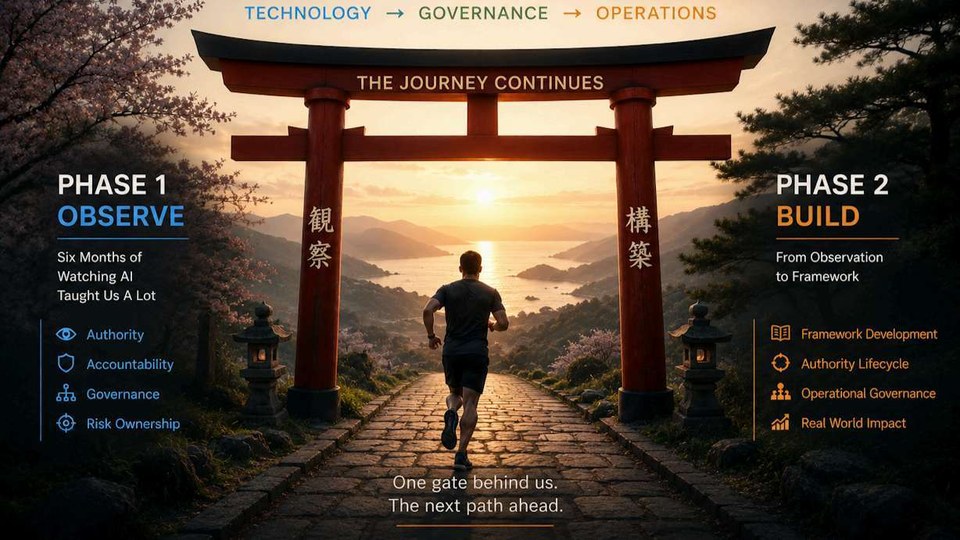
With Issue 10, Phase 1 of this newsletter series comes to a close.
When the series began, the objective was simple: observe the rapidly evolving AI landscape and identify recurring patterns across government, industry, defense, and technology.
Over time, those patterns became increasingly difficult to ignore.
Questions of capability evolved into questions of authority.
Questions of authority evolved into questions of accountability.
Questions of accountability are now evolving into questions of governance, risk ownership, and authority restoration.
Those observations suggest that the next challenge facing organizations may not be building more capable AI systems. It may be developing governance structures capable of integrating those systems into real-world operations.
Phase 2 will focus on that challenge.
The objective is not additional commentary.
The objective is framework development.
Future efforts will focus on operational governance, authority lifecycle management, accountability structures, case studies, and the development of Control Point AI as a practical framework for understanding how organizations govern AI-enabled operations.
The questions remain the same.
Who has authority?
Who owns the risk?
And when governance fails, how is authority restored?
Those questions will continue to guide the journey ahead.