Issue 2
When AI Moves Faster
Frames the gap between technology, governance, and operations when AI-assisted work accelerates beyond traditional review cycles.
By Wayne Couch ·
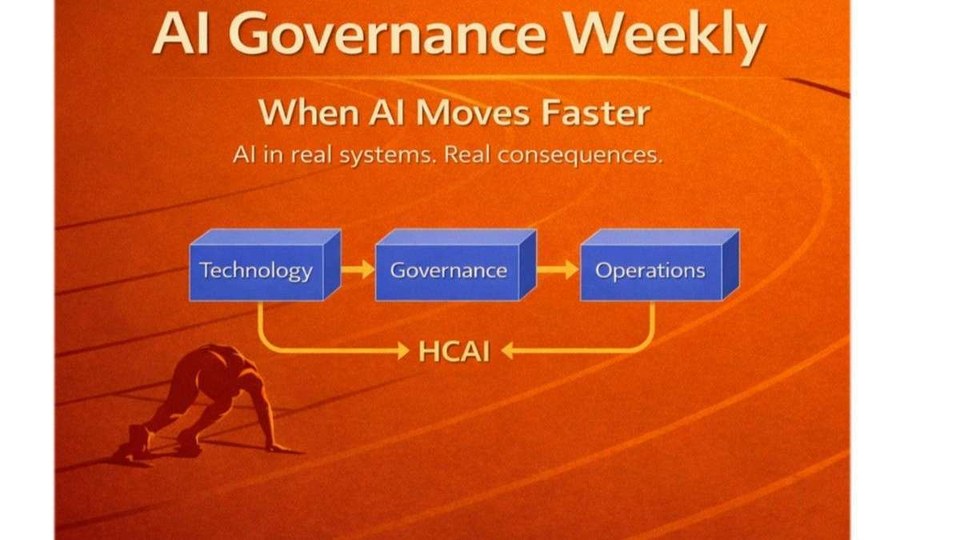
Technology Is Moving Faster Than Authority
Much of today's AI discussion centers on speed - faster sensors, faster models, faster deployment. But as unmanned systems scale and AI integration accelerates, the limiting factor is no longer technical capability.
It is the alignment between signal velocity and decision authority.
This issue examines three connected developments: the industrial-scale expansion of drone procurement, the rapid push to field AI agents across operational environments, and the widening gap between detection speed and authorization structures. Together, they point to a structural reality: authority design is becoming the decisive variable in AI-enabled environments.
Signal 1 - The Drone Market Has Shifted from Experimentation to Industrial Scale
Signal Statement
The U.S. Army's decision to engage roughly 25 vendors for low-cost attack drones marks a clear transition from experimental unmanned systems programs to sustained, industrial-scale capability development.
What Changed
For years, small unmanned systems were treated as niche or provisional capabilities. This move departs from that model. By selecting a broad vendor base rather than a single platform, the Army is signaling that unmanned systems are no longer experimental tools, but enduring elements of force structure expected to scale, iterate, and absorb losses.
The structure of the procurement reflects an intent to build a resilient production ecosystem rather than perfect a single design.
Operational Reinforcement
Recent battlefield reporting from Ukraine reinforces why this shift matters. Single-night attacks involving hundreds of drones and missiles show the operational pressure created by massed, attritable capabilities. In these conditions, production capacity, sustainment, and replacement speed become governance concerns.
Why This Matters
Once procurement reaches industrial scale, the center of gravity shifts from platforms to systems. Lifecycle support, software sustainment, AI integration, training, doctrine, and command-and-control integration become decisive factors. Governance and organizational gaps that were tolerable during experimentation become operational liabilities at scale.
Key Insight
Industrial-scale drone procurement signals that scale, speed, and attrition tolerance are now baseline design assumptions. As unmanned systems move from experimentation to production, the limiting factors shift away from technology and toward integration, governance, and operational control.
Signal 2 - The Department of Defense's AI Acceleration Strategy
Signal Statement
The Department of Defense's January 2026 AI Acceleration Strategy formally commits the institution to rapid model integration, vendor refresh velocity, and near-continuous AI deployment. The strategy signals a decisive shift toward execution speed as a central design priority.
What Changed
- Formal adoption of an "AI-first" posture
- Seven Pace-Setting Projects across operational and enterprise domains
- 30-day vendor model refresh requirement
- Explicit directive to remove bureaucratic barriers to integration
Operational Reinforcement
AI agents compress decision timelines. Embedding machine-speed insight into battle management and enterprise workflows tests authority structures designed for human-paced review and layered approval.
Acceleration in model deployment increases pressure on institutional governance capacity.
Why This Matters
When technical execution accelerates but authority structures remain static, friction does not disappear - it relocates. Machine-speed recommendations flowing into human-speed governance create latency, accountability ambiguity, and structural misalignments that can transform minor coordination gaps into serious operational outcomes.
Key Insight
The limiting factor is no longer whether AI can move faster. The limiting factor is whether institutions are structured to decide at the speed they are now engineering.
Signal 3 - Operational Ambiguity Under Accelerated Counter-UAS Conditions
Signal Statement
A temporary airspace shutdown over El Paso followed the deployment of counter-UAS technology against what was initially assessed as a hostile drone. Subsequent reporting indicated that at least one engaged object was a mylar party balloon, highlighting the difficulty of object classification under compressed decision timelines.
What Happened
Federal authorities issued a Notice to Airmen temporarily restricting airspace over El Paso International Airport, citing special security reasons. Reports indicate that counter-drone capabilities were deployed after detection systems identified a potential aerial threat. The restriction was lifted within hours after the threat was assessed as neutralized.
Multiple outlets later reported that the engaged object was not an operational drone but a benign airborne object.
Why This Matters
This event illustrates a structural reality:
Detection systems are improving faster than decision architectures.
As AI-assisted sensing accelerates object identification and threat flagging, the time available for human confirmation narrows. In ambiguous environments - where benign and hostile objects can share similar signatures - confidence thresholds become operationally decisive. In high-tempo environments, unclear confidence thresholds can amplify escalation dynamics.
The issue is not technical capability.
It is governance under uncertainty.
When action authority is exercised at compressed tempo, escalation risk becomes a function of decision design rather than system accuracy.
Connection to Signal 2
Signal 2 examined how accelerating AI integration without redefining authority structures can create friction inside unchanged organizations. The El Paso incident demonstrates how that tension manifests operationally: machine-speed detection feeding human authorization systems still designed for sequential review and layered validation.
Key Insight
As unmanned systems scale (Signal 1) and AI acceleration compresses timelines (Signal 2), ambiguity in real-world engagements becomes a governance challenge rather than a sensing problem.
Industrial scale, accelerated AI integration, and real-world operational ambiguity all point to the same conclusion: technology is no longer the pacing constraint. Authority design is. A human-centered approach does not resist acceleration; it aligns decision rights, accountability structures, and governance models with the tempo AI introduces.
Until authority evolves alongside capability, faster systems will continue to expose friction inside institutions built for a slower era.