Issue 6
Authority Gap at Execution
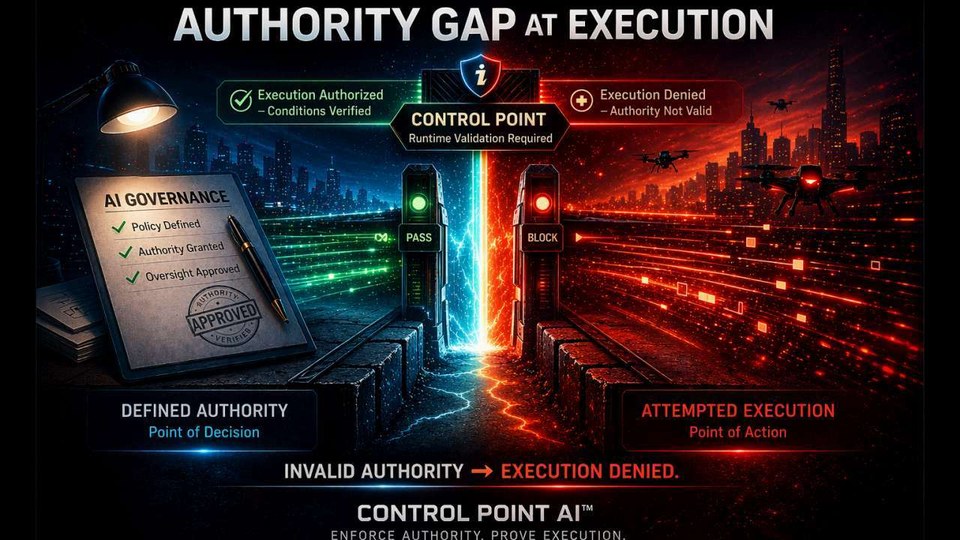
Shows how a defined authority model can still fail when invalid authority is allowed to execute without a live control point.
By Wayne Couch ·
Editor's Note
Issue 6 marks a shift.
Previous issues explored multiple signals across the evolving AI governance landscape. The ideas were sound - but the format forced readers to process too much at once.
Going forward, each issue will focus on a single signal. Shorter. Clearer. More direct.
This issue revisits the most important signal from Issue 5 - refined into a single, executable idea:
Authority is defined - but not enforced at the point of execution.
This is no longer theoretical.
Recent operations against Iranian drone swarms are forcing a rapid shift in how authority is exercised in real time.
Cheap, mass-produced drones are overwhelming traditional defenses built on pre-defined authority and centralized control.
In response, the Department of Defense has accelerated efforts like JIATF-401 - pushing counter-UAS capability, and increasingly decision authority, closer to the point of execution.
But speed of deployment does not guarantee authority is enforced at the moment of action.
The Problem Is Not Governance
Modern governance frameworks are built on a simple assumption:
If authority is defined, it exists.
That assumption no longer holds.
Organizations today are not lacking governance. They have policy. They have approval chains. They have oversight. They have defined roles.
On paper, authority is clear. But AI systems do not operate on paper.
They operate in execution pathways. At machine speed.
The Authority Gap
Authority exists at the point of definition. Execution occurs somewhere else.
Between those two points, something breaks.
Authority is not carried forward. It is not validated. It is not enforced.
It degrades.
t -> t + delta t
At time t, authority is valid. Conditions are known. Approvals are granted. Constraints are defined.
At time t + delta t, execution occurs.
Conditions have changed. Context has shifted. Decisions are being made.
If authority is not revalidated at that moment, it no longer exists in practice.
Execution Without Authority
AI systems now act inside this gap. They trigger actions. They generate outputs. They initiate downstream effects. All at speeds that exceed human decision cycles.
Without execution-time validation, these systems are not operating under authority. They are operating under assumption.
From Governance to Execution
This is not a policy problem. It is an execution problem. Governance defines authority.
Execution determines whether that authority is real. If authority is not enforced within the execution pathway, it is not governing anything.
Control Point AI
Closing this gap requires a shift. Authority must move from documentation into execution. Control Point AI is built on four conditions:
- Authority explicitly defined
- Constraints enforced before execution
- Validation performed at runtime
- Accountability captured after action
Not as policy overlays. As execution conditions.
The Principle
No valid authority -> no execution
Closing
AI has not created a new problem. It has exposed an old one. For decades, organizations have assumed that defined authority would hold through execution. That assumption no longer survives contact with machine-speed systems.
Authority that is not enforced at execution does not exist.