Issue 7
Closing the Gap: Engineering Authority at the Point of Execution
Maps the Control Point AI idea across model outputs, agents, governance layers, policy, dashboards, and audit evidence.
By Wayne Couch ·
Editor's Note
Issue 7 marks the transition from signal to system.
Previous issues identified the gap: authority is defined - but not enforced at the point of execution.
This issue shows how to close it.
The Problem
Something is off. The system is executing. The outputs look valid. But the conditions have changed - and no one has stopped it.
In high-consequence environments, this is where work stops. In AI systems, it often doesn't.
Execution continues - even after authority has effectively expired.
The Signal
This model reflects operational control structures used in high-consequence environments.
The structures in this model are drawn from real-world operational environments where work is continuously authorized, monitored, and controlled under changing conditions - where execution cannot proceed without verified authority.
AI systems are now operating inside real-world missions.
Authority is still treated as something granted upstream - through policy, approval, or design - rather than something that must be continuously validated at execution.
Execution continues... even after authority has effectively expired.
That is the failure mode.
The Shift
Control Point AI reframes governance as an execution problem.
Authority is not assumed.
It is verified - continuously, at execution.
At defined control points, the system must answer:
Is this action still authorized - right now?
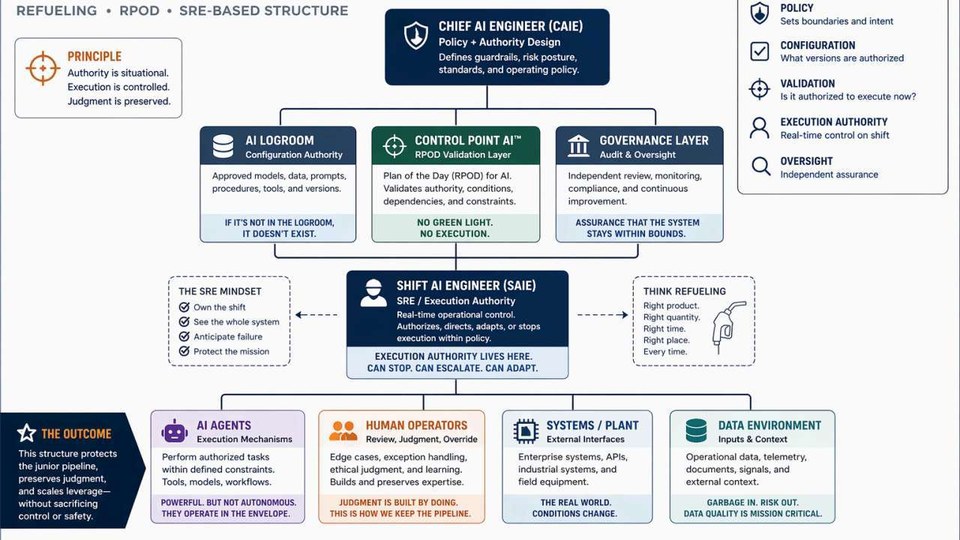
The System
(Control Point AI Operating Model)
Authority Roles
(Who holds authority)
- Chief AI Engineer (CAIE) - Policy & Authority Design. Defines guardrails, risk posture, and authority boundaries.
- AI Logroom - Configuration Authority. Approved models, data, prompts, and tools. Rule: If it's not in the logroom, it doesn't exist.
- Shift AI Engineer (SAIE) - Execution Authority. Real-time operational control. Can authorize, adapt, stop, or escalate execution.
Control Layers
(How Authority is Enforced)
- Control Point AI - RPOD Validation Layer. Validates authority, conditions, dependencies, and constraints. Rule: No green light - no execution.
- Governance Layer - Oversight. Independent monitoring, audit, and assurance.
Execution Layer
(How Authority is Executed)
Example: Execution Under Control
An AI agent initiates an action - querying data, generating output, or triggering a system response.
Before execution proceeds:
Configuration is validated at the control point against the AI Logroom baseline.
- Model ID and version match an approved configuration.
- Data sources are authorized and current.
- Tools and integrations are permitted.
- Execution configuration matches the approved baseline.
The Shift AI Engineer (SAIE) retains authority to intervene, adjust, or stop execution in real time.
- If any check fails - execution does not proceed.
- If conditions have changed - execution is revalidated.
- If constraints are violated - execution is stopped.
- If authority is no longer valid - execution is denied.
Bottom Line
AI is not autonomous. It operates inside a continuously validated authority envelope.
If authority is not enforced at the point of execution, it does not exist.
Control Point AI turns governance into a system that holds -
- At runtime.
- Under pressure.
- As conditions change.
We don't just automate work.
We control how work gets done.
Closing Thoughts
As systems become more distributed, dynamic, and automated, authority naturally separates from execution.
We've seen this pattern before.
Structures that once held control through hierarchy and policy must be rebuilt inside the system itself - through real-time validation, constraint enforcement, and operational control.
AI is not creating a new problem. It is exposing an old one under faster conditions.
The question is no longer whether authority is defined - but whether it can still be held as the system moves.
Control Point AI is not about defining authority. It is about ensuring it still exists at the moment of execution.