Issue 3
Technology Is Moving Faster Than Authority
Explores why governance has to account for delegation, consequence boundaries, accountability chains, revocation, and override.
By Wayne Couch ·
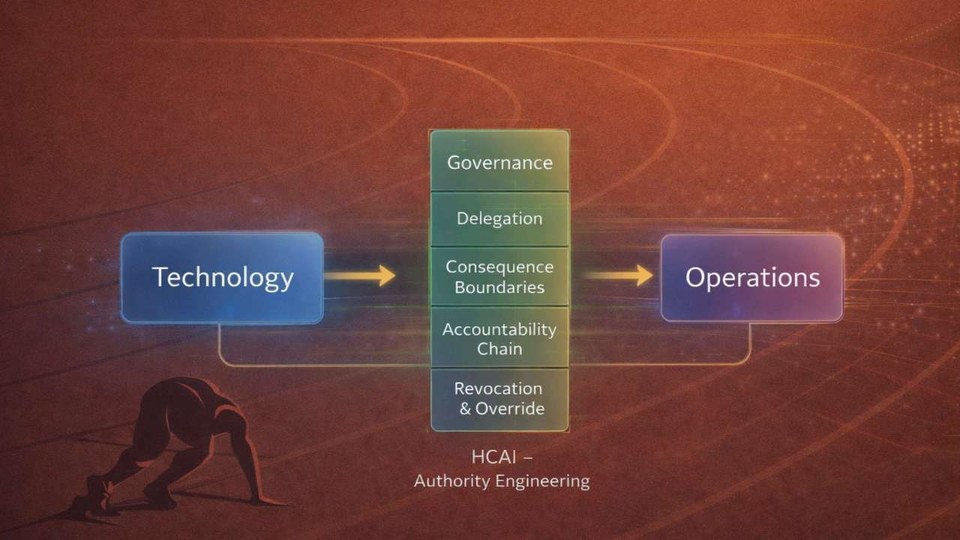
Over the past several issues, a consistent pattern has emerged.
AI capability is accelerating - faster models, faster sensing, faster deployment cycles. But the real constraint is no longer technical performance. It is authority alignment.
As AI systems scale into operational environments, the limiting factor becomes structural: who is authorized to decide, under what conditions, and with what accountability.
This issue reflects a directional clarification. The signals we've been tracking - autonomy boundaries, production pressure, delegation mechanics, audit-clean governance - are not isolated observations. They point toward a deeper structural reality.
Authority design is becoming the decisive variable.
So before moving forward, we are formalizing the mission and vision behind this work.
Signal 1 - Human-Centered AI Integration Formalizes Its Direction
Signal Statement
Human-Centered AI Integration is formally clarifying its mission and long-range vision to focus explicitly on authority design in high-consequence and safety-critical AI environments.
What Changed
Earlier issues examined external developments: industrial-scale drone procurement, rapid AI acceleration policy, and emerging governance asymmetries. Across those signals, a consistent theme emerged.
Rather than treating authority drift as a side observation, this issue formalizes it as the central design problem.
Mission 2.0 narrows the focus from broad AI governance commentary to operational authority engineering - specifically the design of delegation, boundary enforcement, and accountability mechanisms in mission-critical systems.
Vision 2.0 sharpens the long-term aim. Where earlier framing emphasized responsible AI integration, Vision 2.0 makes the accountability principle explicit in AI-enabled decision-making. It clarifies that authority must remain clearly human, delegation must be explicit, and responsibility must never become ambiguous.
Together, Mission and Vision 2.0 move this work from general governance discussion to a defined architectural lane centered on human authority in high-consequence environments.
Operational Reinforcement
Across defense and critical infrastructure domains, AI systems are moving quickly. Policy and technology language increasingly emphasizes speed, scale, and continuous model refresh. Yet formal authority models - delegation chains, accountability boundaries, revocation mechanisms - remain largely unchanged.
As AI systems advance the moment at which decisions become actionable, organizations are forced to confront an uncomfortable reality: technical acceleration without authority redesign creates structural strain.
Why This Matters
In high-consequence environments, ambiguity in authority is not theoretical risk - it is operational risk.
When delegation is implicit, when autonomy is treated as a static designation rather than a bounded runtime condition, and when responsibility is diffused across code, operators, and procurement channels, accountability degrades.
Mission and Vision 2.0 clarify the lane:
We design authority structures so AI can operate safely in mission-critical systems.
Key Insight
As AI systems scale, authority design becomes the decisive variable.
Mission & Vision 2.0 (Formal Statement)
Vision 2.0
Human-Centered AI Integration exists to ensure that artificial intelligence strengthens, never replaces, accountable human decision-making in high-consequence and safety-critical environments.
Our vision is a future where AI operates within clearly defined human authority, where delegation is explicit, boundaries are enforced, and responsibility is never ambiguous.
If AI makes a decision, we should always know who is accountable.
Mission 2.0
Human-Centered AI Integration helps high-consequence and mission-driven organizations design clear authority frameworks for AI adoption.
We advise leaders on how to define delegation, enforce boundaries, and preserve accountability as AI systems are introduced into operational environments.
Our focus is ensuring that AI enhances performance without compromising command integrity, public trust, or human responsibility.
Signal 2 - AI Agents Advance the Consequence Boundary
Signal Statement
As AI agents move from advisory tools to embedded decision support systems, they are advancing the point at which operational decisions become actionable - compressing the time available for human authorization and accountability.
What Changed
In traditional decision support, authority remained clearly downstream.
AI agents alter that dynamic.
Modern agent architectures increasingly integrate sensing, analysis, recommendation, and task initiation into a single loop. In operational environments, this compresses the interval between insight and action.
Recommendations arrive earlier, with higher confidence, and often pre-packaged with execution pathways.
The consequence boundary - the moment at which a decision materially affects real-world outcomes - moves forward in time.
Organizations, however, often retain decision structures designed for slower informational tempo.
Operational Reinforcement
Emerging AI deployment strategies emphasize:
- autonomous agent experimentation
- machine-speed decision-support
- reduced latency between data ingestion and recommended action
- integration of agents into battle management and enterprise workflows
In each case, the technical system reduces friction between detection and execution.
But authorization models - delegation chains, approval checkpoints, escalation paths - frequently remain anchored to legacy review cycles.
This creates a structural mismatch: machine-speed insight feeding human-speed authority frameworks.
Why This Matters
When the consequence boundary moves forward but authority structures do not, two predictable responses emerge:
- Informal delegation expands to keep pace.
- Human oversight becomes performative rather than decisive.
Neither outcome is engineered - both are adaptive reactions to tempo pressure.
In high-consequence environments, this drift introduces ambiguity in accountability. If a recommendation is operationally irreversible by the time it reaches a human decision-maker, the formal approval becomes symbolic.
Authority must move with consequence.
Key Insight
AI agents do not merely automate tasks. They advance the moment at which decisions become real.
If the consequence boundary moves, the authority boundary must move with it.
Designing that alignment is not a policy problem.
It is an engineering problem.