Issue 9
The Execution Authority Gap
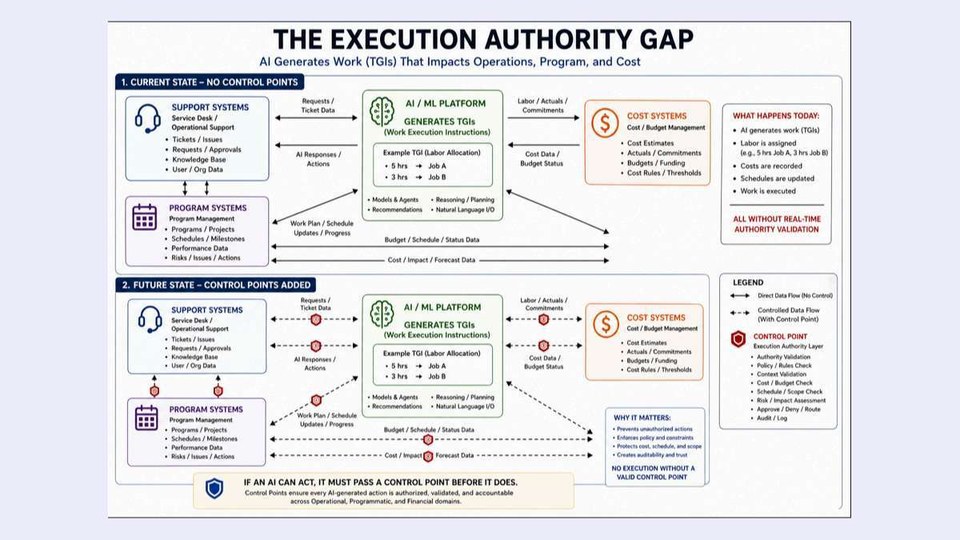
The key reference for Data Flow Mapping: explains how AI-generated work can propagate through connected systems before authority is validated.
By Wayne Couch ·
Editor’s Note
Over the last several months, much of the AI governance discussion has focused on policies, frameworks, inventories, principles, and compliance structures.
Those discussions remain important.
But something else is beginning to emerge underneath the surface.
Organizations are increasingly discovering that AI governance failures rarely originate from isolated models alone. Instead, they are beginning to emerge through interconnected execution pathways spanning workflows, scheduling systems, budgeting systems, operational platforms, delegated AI-enabled actions, and increasingly coupled decision environments.
The problem is quietly evolving from a model-governance challenge into an execution-flow governance challenge.
That distinction matters.
Because once AI-enabled systems begin interacting across operational environments at machine speed, static governance artifacts alone may no longer provide sufficient operational control.
The Collapse of Point-in-Time Governance
For years, many governance structures were built around periodic control mechanisms: annual reviews, static approvals, compliance snapshots, certification cycles, scheduled audits and point-in-time risk assessments.
AI changes the tempo.
Modern AI-enabled environments increasingly involve: dynamic workflows, delegated execution pathways, continuously evolving operational conditions, interconnected support systems, machine-speed coordination, and cross-domain propagation of decisions and recommendations
The question increasingly becomes:
“Who owns the risk under current operational conditions — not yesterday’s conditions?”
AI Governance Is Becoming an Execution-Flow Problem
AI systems are increasingly being embedded into scheduling systems, operational platforms, logistics workflows, acquisition systems, financial systems, and enterprise workflow automation.
The governance challenge is no longer limited to whether a single AI model behaves properly in isolation.
The challenge increasingly involves understanding how execution flows propagate across interconnected systems.
That is a systems-engineering problem as much as a compliance problem.
The Execution Authority Gap
AI systems are no longer functioning solely as passive advisory tools.
They are increasingly generating work execution instructions that directly impact:
- operational systems
- program systems
- cost systems
- scheduling systems
- support workflows
- enterprise execution environments
This creates what may increasingly become known as the Execution Authority Gap.
The problem is not simply that AI can generate recommendations.
The problem is that AI-generated actions can now propagate operational effects across interconnected systems before authority is fully validated at the point of execution.
The Control Point AI conceptual model illustrates the difference between:
- uncontrolled execution propagation
- execution pathways with embedded runtime authority validation
The future-state model introduces embedded control points directly into execution pathways.
These control points validate:
- authority
- policy constraints
- budget availability
- schedule validity
- operational scope
- context at time of execution (t + Δt).
before operational effects are allowed to propagate.
Core Principle
“If an AI can act, it must pass a control point before it does.”
Hidden Operational Coupling
AI-enabled integration increasingly connects previously semi-isolated domains together.
This creates:
- hidden dependencies
- cascading operational effects
- synchronization risk
- reduced visibility into decision pathways
- authority drift across organizational boundaries
Organizations may believe they are implementing productivity improvements.
Operationally, however, they may also be creating new execution pathways that propagate risk across domains faster than traditional governance mechanisms can observe.
Execution Example: Authority Enforcement in Practice
Consider a scenario where an AI-enabled system generates tasking instructions allocating labor across multiple job orders:
- 5 hours → Job A
- 3 hours → Job B
Before execution, each action passes through a control point.
If a job order is invalid at the moment of execution, the action is blocked.
Examples include
- overspent job orders
- funding expiration
- COAR discrepancies
- out-of-scope work
- schedule conflicts
- unauthorized operational tasking
Under traditional governance models, these problems are often discovered after execution.
Under a Control Point AI model, the work is prevented from executing before operational effects occur.
This means
- no labor is charged
- no invalid schedule update occurs
- no unauthorized work proceeds
- no downstream propagation is triggered
Invalid work does not fail after execution.
It is prevented from executing at all.
Runtime Governance Versus Paper Governance
Many organizations currently possess governance artifacts that appear mature on paper:
- governance councils
- AI principles
- inventories
- compliance frameworks
- oversight committees
But recent operational signals increasingly suggest that paper governance alone may not provide sufficient runtime control once AI-enabled systems begin operating across interconnected execution environments.
Static governance does not automatically create runtime authority enforcement.
Operational accountability increasingly depends on whether organizations can:
- maintain visibility into execution flows
- validate operational boundaries dynamically
- understand authority propagation
- detect synchronization failures early
- preserve accountability under changing conditions
The Emerging Shift
The broader market conversation appears to be evolving.
Only a year ago, much of the AI governance discussion focused primarily on ethics, principles, and responsible AI statements.
Today, the discussion increasingly involves:
- operational accountability
- runtime visibility
- execution authority
- system coupling
- organizational resilience
- machine-speed operational coordination
This may represent the beginning of a larger transition from governance as documentation toward governance as operational engineering.
Conclusion
The organizations most likely to succeed in AI-enabled operational environments may not necessarily be those with the largest governance manuals.
They may instead be the organizations that learn how to:
- embed operational control into execution pathways
- maintain runtime visibility
- engineer authority boundaries directly into workflows
- preserve accountability under dynamic conditions
- validate execution integrity continuously rather than periodically
The future of AI governance may depend less on static compliance artifacts and more on whether organizations can engineer operational control directly into increasingly dynamic execution environments.
That is not merely a policy problem.
It is becoming an operational systems-engineering problem.