Issue 5
When Authority Breaks at Machine Speed
Presents the HCAI / Control Point AI framework as an execution-bound loop for defining, constraining, monitoring, auditing, and refining authority.
By Wayne Couch ·
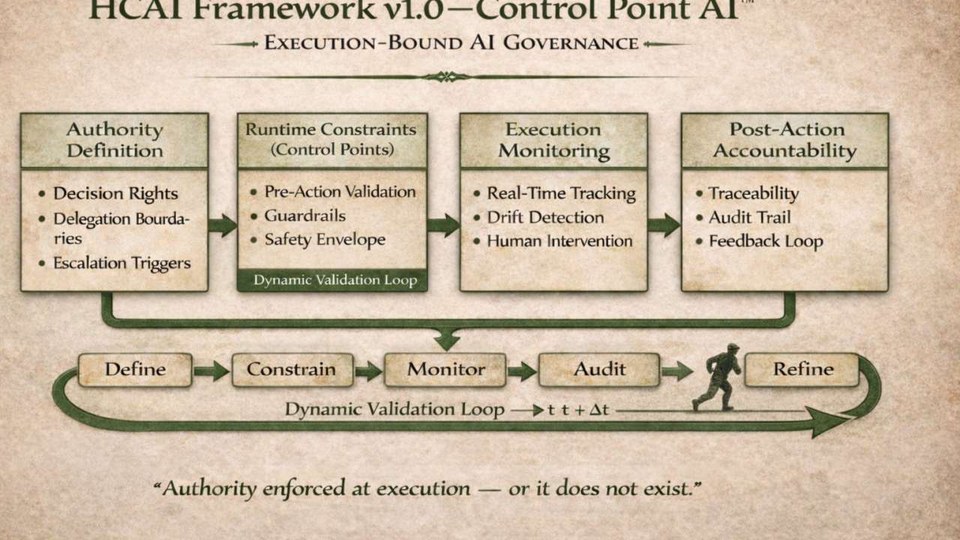
AI systems are now operating at speeds and in environments where traditional governance structures can no longer keep pace. Across defense, public safety, and emerging AI-enabled operations, the gap between system capability and institutional control is widening - not because authority is undefined, but because it is not enforced at the point of execution.
In this issue, we examine three converging developments: the shift from policy-based governance to execution-bound authority, the movement of battlefield capabilities into civilian and partner environments, and the growing mismatch between operational tempo and organizational decision-making.
When systems act at machine speed, authority is no longer a background condition. It becomes the decisive factor in whether control is maintained - or quietly lost.
Signal 1 - From AI Governance to Execution-Bound Authority
Signal Statement
As AI systems move into operational environments, authority can no longer remain implicit or policy-based - it must be explicitly engineered directly into execution.
What Changed
As AI systems transition from analytical tools to operational actors, traditional governance structures begin to break down.
Most governance today exists in documentation, policy, and oversight. But in AI-enabled systems, decisions increasingly occur at machine speed.
This creates a fundamental gap: authority is defined, but not enforced at the point of execution.
Operational Reinforcement
Across AI deployment discussions, several patterns are becoming clear:
- Increasing integration into real-time operational workflows
- Expanding use of autonomous and semi-autonomous decision pathways
- Compression of time between detection, analysis, and action
- Expansion of AI roles beyond advisory into execution-adjacent functions
In each case, the system's ability to act is accelerating.
But governance mechanisms - approval chains, policy constraints, and oversight structures - often remain external to execution.
This separation creates risk:
Authority exists in documentation, but not at the point of execution.
Why This Matters
Once decisions occur at machine speed, governance is no longer theoretical.
It either holds under execution... or it fails.
If authority is not embedded directly into how systems operate, then constraints can be bypassed, accountability becomes ambiguous, and control degrades under tempo.
In high-consequence environments, this is not a policy issue.
It is an operational risk.
Key Insight
Authority is not a condition established at execution (t).
It must be continuously validated as conditions evolve (t + delta t).
Governance that is not embedded in execution - and not maintained over time - degrades under real-world conditions.
Framework Introduction (Control Point AI)
This shift points toward a different model:
Execution-bound authority, formalized as Control Point AI.
In this model, authority, constraints, and accountability are engineered directly into the runtime pathways of AI-enabled systems through:
- Explicit definition of authority
- Pre-execution constraint enforcement
- Real-time monitoring of decisions
- Full post-action accountability
Control points act as dynamic validation gates, ensuring systems remain within their authorized operational envelope as conditions change.
Authority that is not continuously validated will not hold at execution.
Signal 2: When Battlefield Capabilities Enter Civilian Airspace
Signal Statement
Battlefield-proven counter-drone capabilities are now entering civilian and partner environments - collapsing the boundary between warfighting and domestic operations without a corresponding framework for authority, control, or accountability.
What Changed
Recent reporting on Ukraine deploying counter-drone capabilities into multiple Middle East countries highlights a new phase:
Operational experience from active conflict is now being exported directly into environments that are not structured as battlefields.
These systems - and the concepts behind them - were developed under conditions where:
- threats are adaptive
- timelines are compressed
- decisions must be made immediately
That is the context they are optimized for.
But they are now being introduced into environments governed by civilian authorities, legal constraints, and fragmented chains of responsibility.
The boundary is not theoretical anymore.
It is operational - and already crossed.
Operational Reinforcement
This shift is visible across multiple dimensions:
- Adoption of combat-proven counter-UAS systems outside active conflict zones
- Increased emphasis on rapid detection-to-effect timelines
- Interest in layered defenses modeled on battlefield architectures
- Expansion of these capabilities into partner nations and domestic security contexts
But the governance models surrounding these deployments have not kept pace.
In many cases, authority remains diffuse:
Who can act? Under what conditions? With what level of autonomy? And who is accountable if the system is wrong?
These questions are often answered after deployment - not engineered into the system beforehand.
Why This Matters
For senior decision-makers - including state authorities, regulators, and operational leaders - this creates a new kind of risk:
Not just whether a system works...
But whether it acts within the bounds of authority when conditions change rapidly.
Because in these environments:
- decisions may need to occur in seconds
- threats may not be clearly attributable
- actions may have legal, political, and safety consequences
Without explicit control over how authority is exercised at machine speed, responsibility becomes unclear at exactly the moment it matters most.
This is not a technology problem.
It is an authority and accountability problem under time pressure.
Key Insight
As battlefield capabilities move into civilian environments, governance cannot remain external to the system.
At the point where decisions must be made in seconds - often with incomplete information and real-world consequences - authority can no longer be assumed, deferred, or interpreted after the fact.
It must be explicitly defined, bounded, and enforced at the moment of action.
Control Point AI provides a way to do this:
By embedding authority, constraints, and accountability directly into the decision pathway - ensuring that even under compressed timelines, systems act within clearly defined operational and legal bounds.
Without this, the risk is not just system failure.
It is loss of control over who is actually making decisions, under what authority, and with what accountability.
Signal 3 - Organizational Tempo Is No Longer Aligned with Operational Reality
Signal Statement
As AI-enabled systems and drone threats operate at machine speed, organizations built for slower review cycles face a widening authority mismatch.
What Changed
Advances in AI and drone technology are compressing the time between detection, decision, and action.
In operational environments, this compression is no longer theoretical.
Threats are identified, evaluated, and acted upon in seconds - sometimes faster.
But most organizations responsible for deploying, managing, and governing these systems still operate on fundamentally different timelines:
- Procurement cycles measured in months or years
- Governance updates measured in quarters
- Decision-making chains designed for deliberate review
The result is a structural misalignment:
The system operates at machine speed. The organization does not.
Operational Reinforcement
Across defense, public safety, and critical infrastructure domains, several patterns are emerging:
- Increased reliance on real-time or near-real-time decision support
- Pressure to shorten detection-to-response timelines
- Expansion of AI-enabled systems into operational roles
- Growing expectation that systems will act faster than human review cycles allow
At the same time:
- Acquisition processes remain slow and compliance-heavy
- Governance frameworks lag behind deployment realities
- Human approval chains persist even when tempo makes them impractical
Organizations are attempting to operate high-speed systems within low-speed structures.
Recent reporting indicates that Ukrainian drone defense expertise is now being exported as demand for counter-UAS capability is rapidly increasing.
This reflects a different kind of adaptation:
Instead of waiting for formal procurement cycles or fully developed institutional frameworks, organizations are importing operational experience directly from active conflict environments.
Knowledge, tactics, and capability are moving at operational speed - even as formal structures struggle to keep pace.
Why This Matters
When operational tempo exceeds organizational tempo, two predictable adaptations occur:
- Informal delegation expands to keep pace
- Formal oversight becomes delayed or symbolic
Neither outcome is designed - both are reactive.
In high-consequence environments, this creates risk:
Decisions are effectively made at machine speed...
This gap is where control degrades.
Key Insight
The threat operates at machine speed.
Organizations that respond at human speed will not maintain control.
The solution is not simply to accelerate decision-making.
It is to re-engineer how authority is structured and executed at speed.
Authority, constraints, and accountability must be embedded directly into system operation - not layered on after the fact.
This is the shift:
From governance as oversight to governance as execution
From human-paced control to control points operating at machine speed
Aligning operational tempo with authority, governance, and decision structures is no longer optional.
It is a prerequisite for maintaining control in AI-enabled systems.